
Kitchen Gadgets in Pakistan: What’s Actually Worth Buying?
On this page
- What Makes a Kitchen Gadget Worth Buying?
- 1. A Food Chopper for Everyday Prep
- 2. A Hand Blender When You Want Less Setup and Cleanup
- 3. A Vegetable Slicer or Multi-Function Cutter for Repetitive Cutting
- 4. An Oil Sprayer When You Want Better Control Over Oil Application
- 5. A Foldable Colander When Storage Space Is Limited
- 6. A Spice Rack or Organizer if Cooking Ingredients Are Hard to Find Quickly
- 7. An Electric Kettle if You Regularly Need Hot Water
- Which Kitchen Gadgets Should You NOT Buy?
- Manual vs Electric Kitchen Gadgets
- How to Choose Kitchen Gadgets for a Pakistani Home
- Building a Useful Kitchen on a Budget
- Browse Kitchen Gadgets at ZARAK
- FAQ
A kitchen gadget can look useful in a product video and still spend most of its life at the back of a cabinet.
Before buying one, ask a simpler question: what repetitive job will this tool actually remove from your routine?
For one household, that might be chopping onions, green chillies, garlic and herbs every day. For another, the bigger problem may be crowded shelves, repeated blending, or needing hot water several times a day.
A useful kitchen gadget should earn the space it takes up. It should solve a real problem often enough to justify buying, washing and storing it.
That is a better way to choose kitchen gadgets in Pakistan than starting with a generic list of whatever happens to be popular.
What Makes a Kitchen Gadget Worth Buying?
The most useful kitchen gadgets are usually the ones that remove friction from a task you already perform regularly.
A gadget becomes less attractive when the job it replaces takes two minutes but the gadget needs ten minutes of assembly, washing and storage afterwards.
Before ordering, check the following:
| What to consider | What to ask yourself |
|---|---|
| Frequency of use | How often do I actually perform this task? |
| Problem solved | What specific inconvenience will this gadget remove? |
| Cleaning effort | Will I still use it if several parts need washing? |
| Storage | Do I have room for it when it is not being used? |
| Manual or electric | Is the workload large enough to justify electricity and a motor? |
| Capacity | Is the size appropriate for my household and normal portions? |
This framework matters more than how impressive a gadget looks online.
For example, someone preparing onions, garlic, ginger and green chillies almost every day may get regular use from a chopper. Someone who prepares a small meal occasionally may find that a knife and chopping board already do the job perfectly well.
The same rule applies to organisers, blenders, kettles and almost every other kitchen tool.
1. A Food Chopper for Everyday Prep
A food chopper makes the most sense when chopping is a recurring part of your cooking rather than an occasional inconvenience.
Pakistani cooking often involves repeated prep such as onions, green chillies, garlic, ginger and herbs. Tomatoes may also be suitable for some chopping tasks depending on the texture you want and the type of chopper being used.
If you regularly prepare these ingredients, a compact chopper can reduce the amount of repetitive knife work involved.
The decision then becomes manual versus electric.
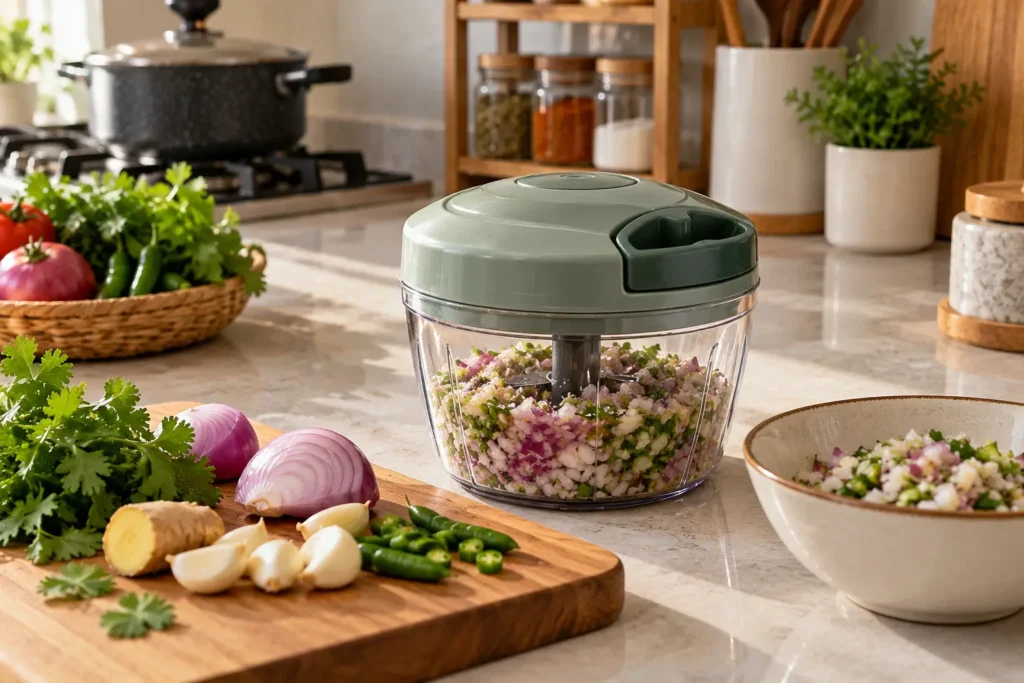
A manual food chopper does not depend on electricity and is often convenient for quick, smaller jobs. ZARAK’s 1.5L Manual Food Chopper uses a pull-cord mechanism, has a 1.5-litre capacity and requires no electricity.
That format may suit someone who wants a relatively simple tool that can be stored away and used whenever needed.
An electric chopper can make more sense when the quantities are larger or chopping is frequent enough that repeated manual operation becomes inconvenient. The trade-off is that electric models need a power source and may have different cleaning, storage and maintenance requirements depending on the model.
Cleaning deserves attention here. If you dislike washing multiple components after every use, look closely at how the chopper comes apart before buying.
And if you only chop a small onion or a few chillies once in a while, you may not need a chopper at all.
For more options, browse ZARAK’s Food Preparation collection.
2. A Hand Blender When You Want Less Setup and Cleanup
A full-size blender is useful for many jobs, but bringing it out for every small blending task can feel excessive.
A hand blender may be more convenient when you regularly want to blend something directly in an appropriate container without setting up a larger appliance.
The main advantage is not that a hand blender is universally better. It is that the format can be better matched to certain recurring jobs.
Someone who frequently prepares blended mixtures in smaller quantities may find a hand blender easier to reach for. A household already satisfied with its existing blender, however, may not gain much from owning another appliance that performs overlapping work.
ZARAK’s RAF 4 Blade Hand Blender, One Speed is a single-speed model with a four-blade configuration.
Before choosing any hand blender, consider the tasks you expect it to handle, how easy its blending end is to wash, where you will store it and whether a single-speed or adjustable-speed model better suits your needs.
A product should fit your routine rather than force you to change the routine around the appliance.
3. A Vegetable Slicer or Multi-Function Cutter for Repetitive Cutting
Vegetable slicers and multi-function cutters are most useful when you repeatedly perform the type of cutting they are designed to simplify.
Uniform slicing is one obvious reason to consider one. If you often prepare vegetables in similar shapes or quantities, a dedicated cutter may reduce repetitive knife work and produce more consistent pieces.
That benefit matters much less to someone who rarely performs those tasks.
The main mistake is buying a multi-function cutter because it has many attachments rather than because you will regularly use those functions.
More components can also mean more parts to store and clean. Before ordering, think about which attachments you would genuinely use, how easily the tool can be washed and whether the full set will fit comfortably in your cabinet.
A simpler tool that solves one frequent problem can be more useful than a larger set that solves six problems you rarely have.
Relevant options can be explored in ZARAK’s Food Preparation and Cookware & Cooking Tools sections.
4. An Oil Sprayer When You Want Better Control Over Oil Application
An oil sprayer is a fairly specific tool. Its main value is control.
Instead of pouring oil directly from a bottle, a sprayer can help distribute a smaller or more controlled amount across a pan or food surface.
That can be useful when you want a lighter, more even application for a particular cooking task.
It should not be treated as a health product, and using an oil sprayer does not automatically make food healthier. The amount and type of oil you use still depend on your cooking choices.
ZARAK’s 100ml Oil Sprayer Bottle has a 100ml capacity.
Before buying an oil sprayer, consider how often you would actually use spray application. If you normally need measured tablespoons of oil for curries, gravies or other recipes, a conventional bottle may still be the more practical tool for those jobs.
The sprayer is useful when the application method itself solves a real problem.
5. A Foldable Colander When Storage Space Is Limited
A colander has a simple job: holding food while water drains away.
The reason a foldable version may be useful is equally simple. It takes up less space when collapsed.
That matters more in kitchens where cabinets and drawers are already crowded. A full-size rigid strainer may work perfectly well, but it occupies the same amount of space whether you are using it or not.
A foldable colander can be a sensible alternative for rinsing or straining tasks when compact storage is a priority.
ZARAK carries a Foldable Silicone Colander / Strainer Basket.
The buying decision should still be based on how you cook. If you already own a strainer that fits comfortably in your kitchen, replacing it simply because another version folds may not add much value.
Compact design matters when it solves an actual storage problem.
6. A Spice Rack or Organizer if Cooking Ingredients Are Hard to Find Quickly
Kitchen organisers do not make food preparation faster by magic. What they can do is make frequently used ingredients easier to see and reach.
That can be useful in kitchens where masalas, seasoning jars and other cooking items gradually spread across shelves or counters.
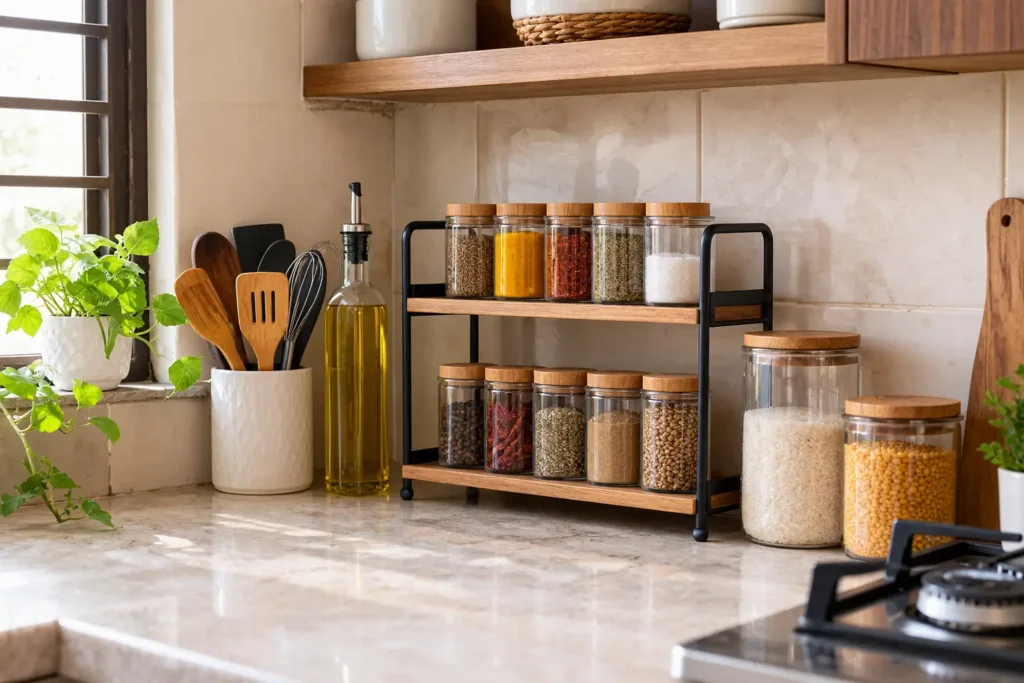
A spice rack may help if you regularly find yourself moving several containers just to reach the one you need.
ZARAK’s 2 Layer Metal Spice Rack provides two levels for organising kitchen items.
Before buying any organiser, measure the area where you intend to place it. Also look at the containers you already own. A rack is only useful if the available height, width and shelf arrangement work with the items you plan to store.
For wider storage needs, ZARAK’s Kitchen Racks & Holders and Kitchen Storage & Containers collections are more useful starting points than buying an organiser without first identifying where the clutter comes from.
7. An Electric Kettle if You Regularly Need Hot Water
An electric kettle is worth considering when heating water is a task you repeat often.
The more frequently you need hot water, the easier it is to justify owning a dedicated appliance for it. Someone who rarely heats water may find that an existing pot already covers the need.
Capacity matters as well. A kettle that is too small may require repeated boiling for a larger household, while an unnecessarily large kettle may take up more counter or cabinet space than you need.
When comparing electric kettles, check the specifications of the exact model rather than assuming all kettles have the same features. Look for clearly stated capacity, wattage, construction materials, electrical requirements and shut-off features before ordering.
ZARAK’s Kitchen & Dining collection can be used to compare relevant electric kettle options alongside other kitchen tools.
Which Kitchen Gadgets Should You NOT Buy?
You probably do not need a kitchen gadget simply because it looks clever or is currently popular.
Reconsider the purchase if the tool solves a task you rarely perform. The same applies if another appliance in your kitchen already does the job well.
Cleaning can also turn a promising gadget into unused cabinet clutter. If a tool saves one minute during preparation but adds several awkward parts to the washing-up, the trade may not be worth it for you.
Storage is another practical limit. A large appliance may be useful in theory but annoying in a small kitchen if it permanently occupies valuable counter or cabinet space.
Capacity should match the way you cook. Bigger is not automatically better, especially when normal portions are small.
And sometimes the simple option wins. If a knife, peeler, strainer or other manual tool already handles the task comfortably, there is no reason to replace it purely because a more complicated version exists.
Viral products are easiest to judge by asking one question: what will I use this for next week?
If you cannot think of a recurring job, waiting is usually the better purchase decision.
Manual vs Electric Kitchen Gadgets
Neither manual nor electric kitchen gadgets are better in every situation.
Manual tools usually make more sense for smaller jobs, simple storage and situations where electricity should not be necessary. Electric tools become more useful when a task is frequent, physically repetitive or involves larger quantities.
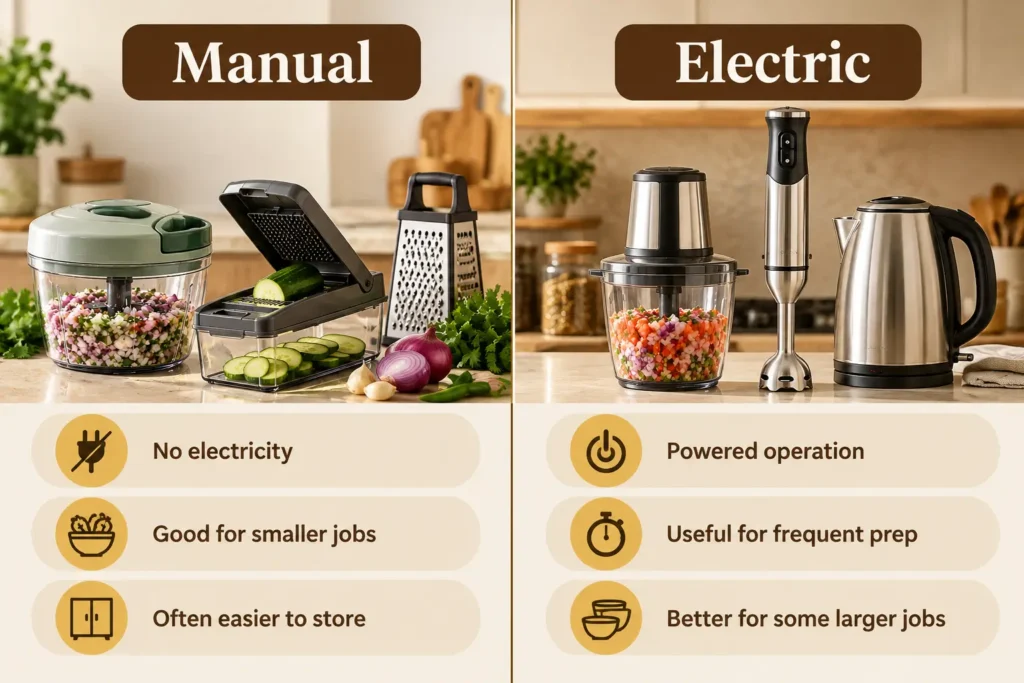
| Factor | Manual gadgets | Electric gadgets |
|---|---|---|
| Electricity | Not required | Required |
| Small jobs | Often convenient | May be unnecessary for very small tasks |
| Frequent or larger prep | Can require more effort | Can reduce repeated manual work |
| Storage | Often compact, depending on design | May need more space |
| Cleaning | Can be relatively simple, but varies by product | Varies by appliance and removable parts |
| Purchase cost | Often lower in general | Often higher in general |
| Best suited for | Quick, occasional or smaller tasks | Frequent, larger or more repetitive tasks |
The right choice depends on workload rather than the assumption that electric automatically means better.
A manual food chopper, for example, can be practical for quick preparation because it needs no power. An electric chopper becomes more attractive when the quantity or frequency makes repeated manual chopping inconvenient.
The same logic can be applied across the kitchen.
How to Choose Kitchen Gadgets for a Pakistani Home
Start with your normal week rather than an ideal version of how you imagine you will cook after buying the product.
Look at frequency first. A task performed every day deserves more attention than one performed once a month.
Match capacity to the household. The right capacity depends on how much food or water you normally prepare at once. Do not automatically choose the largest option.
Check available space. Measure the counter, shelf or cabinet where the gadget will live. Product dimensions matter more when storage is already tight.
Decide whether electricity adds enough value. Manual tools are useful when simplicity and independence from power matter. Electric appliances are easier to justify when they remove enough repetitive effort.
Think about washing before buying. Check how many parts require cleaning and whether the design suits the way you normally wash kitchen tools.
Read the actual seller specifications. Do not assume materials, wattage, safety features, attachments or other details from a similar-looking product.
Check replacement needs where relevant. Some appliances may use parts or accessories that can wear, get misplaced or need replacement.
Review the seller’s return or exchange policy. This is especially useful when ordering kitchen gadgets online in Pakistan, where you cannot physically handle the item before placing the order.
Finally, check what you already own. Buying two products that solve almost the same problem usually gives you more clutter, not a more useful kitchen.
Building a Useful Kitchen on a Budget
If you are working with a limited budget, do not try to build a large kitchen gadgets list all at once.
Start with the job you repeat most often.
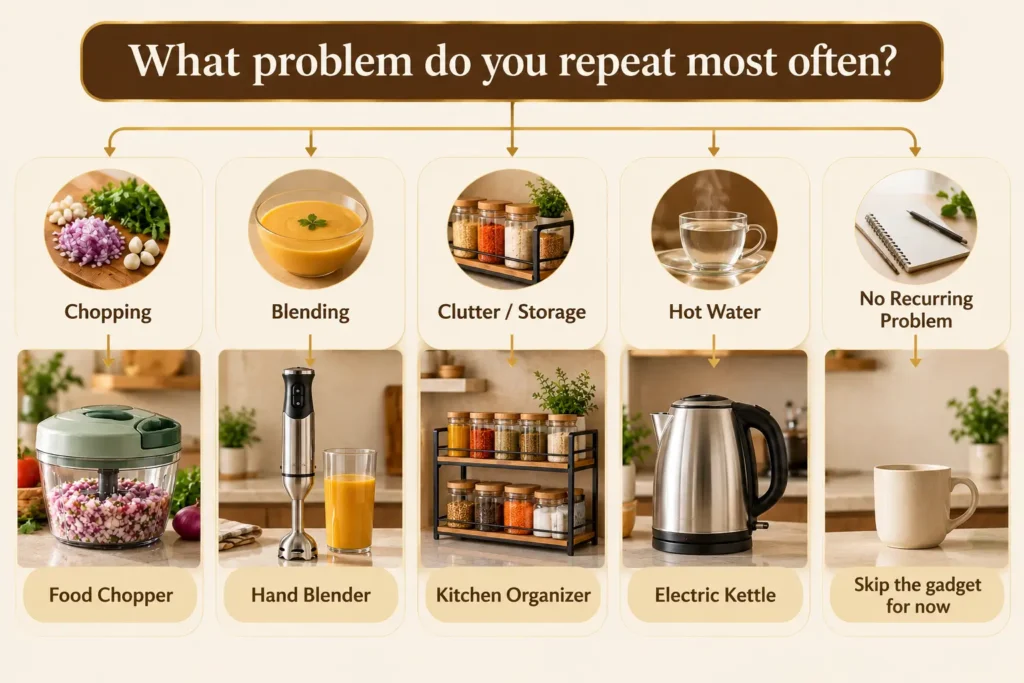
If chopping is the annoying part of daily preparation, consider a chopper first.
If ingredients are difficult to find and shelves are crowded, an organiser may improve your routine more than another appliance.
If you repeatedly bring out a large blender for smaller jobs, a hand blender may be worth comparing.
If you regularly need hot water, an electric kettle may deserve higher priority than a gadget you would only use occasionally.
And if there is no recurring problem, you may not need to buy anything yet.
A useful kitchen is not the one with the most gadgets. It is the one where the tools match the work being done.
Browse Kitchen Gadgets at ZARAK
If you already know which kitchen task you want to make easier, browse ZARAK’s Kitchen & Dining and Food Preparation collections and compare products based on that specific job.
Look at capacity, format, cleaning, storage and the verified specifications of the individual product before deciding.
The goal is not to add another gadget to the kitchen. It is to choose something you will actually use.
FAQ
What are the most useful kitchen gadgets in Pakistan?
The most useful kitchen gadgets are the ones that solve recurring household tasks. Depending on your routine, that may include a food chopper for frequent prep, a hand blender for smaller blending jobs, a spice organiser for clutter, a colander for rinsing and straining, or an electric kettle if you regularly need hot water. Usefulness depends on how often you perform the task.
Which kitchen gadget should I buy first?
Buy the gadget that solves the task you repeat most often. If daily chopping takes the most effort, start with a chopper. If storage and clutter are the bigger problem, start with an organiser. There is no universal first gadget for every kitchen.
Is a manual or electric chopper better?
A manual chopper generally suits smaller, quick preparation jobs and does not require electricity. An electric chopper can make more sense for frequent or larger preparation where repeated manual effort becomes inconvenient. Capacity, cleaning and storage should also influence the decision.
Are expensive kitchen gadgets always better?
No. A higher price does not automatically make a kitchen gadget more useful for your household. The better choice is the product whose capacity, features, construction and format match the job you actually need it to perform.
Which kitchen gadgets are useful for a small kitchen?
Compact and foldable tools are usually easier to accommodate in a small kitchen. Manual choppers, hand blenders, foldable colanders and well-sized organisers may be useful when they replace repetitive tasks without occupying unnecessary storage space. Always check dimensions before ordering.
What should I check before buying kitchen gadgets online?
Check the product’s verified specifications, capacity, dimensions, material information provided by the seller, electrical requirements where relevant, cleaning requirements and return or exchange policy. Also check whether the gadget duplicates something you already own.
Browse ZARAK’s Kitchen & Dining and Food Preparation collections to compare kitchen tools based on the job you actually need them to do, rather than simply choosing what is currently popular.